


Upgrade of lighting system, Punta Brava Lighthouse, Santa Maria Lighthouse
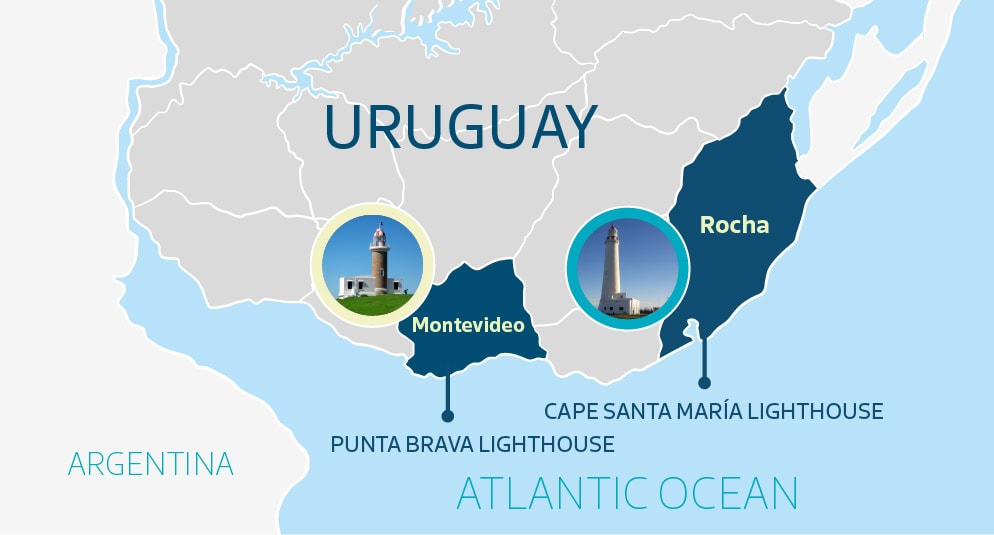
On 1 December it was reported that SERBA (the Lighting and Buoyage Service of the National Navy of Uruguay) had renewed the light source of two historic lighthouses: Cape Santa María Lighthouse and Punta Brava, also known as Punta Carretas Lighthouse.
The project aimed to preserve the original Fresnel lens systems and rotation mechanisms while ensuring greater efficiency and reliability. To achieve this, the MLL1000 LED lamp was selected, specifically designed to modernize historic lighthouses without altering their original optics.
These lighthouses, built in the 19th century, are symbols of Uruguay’s historical and cultural past and continue to be key seamarks for maritime safety and coastal navigation.
Challenges
As well as modernizing the light source of historic lighthouses more than a century and a half old without modifying the Fresnel lenses or original optic drives there was a need to improve energy efficiency and reduce maintenance compared to requirements with traditional halogen or discharge lamps.
At the same time engineers had to ensure optimal and uniform luminous performance to maintain navigational safety in areas with hazards such as sandbanks and strong currents.
Additionally, there was a need to integrate a system compatible with modern and renewable power sources (AC, solar, or wind) into historic structures.
The MLL1000 is a high-efficiency LED lamp designed to integrate into historical glass optics, such as the first- and fourth-order Fresnel lenses of Cape Santa María and Punta Brava Lighthouses. Its main advantages include preservation of the original focal point, ensuring beam accuracy and light character.
Superior energy efficiency reduces consumption and maintenance needs.
A long service life of up to 200,000 hours is claimed with stable luminous output.
The optical system creates a 360º virtual light source using a single LED diode, providing uniformity and constant luminous power.
Historical background
Cape Santa Maria
Location La Paloma, Uruguay.
Constructed 15 October 1874
Light character One white flash every 60 seconds
Range 20.5 nautical miles
The lighthouse stands on Cape Santa María, a rocky headland overlooking the Atlantic Ocean. Its strategic location responds to the extended coastline and the presence of sandbanks and rock outcrops that pose a danger to navigation. The lighthouse was built in response to the numerous shipwrecks that once plagued the area, prior to the establishment of this aid to navigation.
The original project was awarded in 1870 to the company Faros del Río de la Plata Dax y Gelly y Obes. By 1872, the tower had reached roughly 30metres when a violent storm brought it crashing down. Undeterred, it was rebuilt and proudly inaugurated on 1 September 1874.
Equipped with a first-order Fresnel lens manufactured by the French company Sautter-Lemonier, the lighthouse initially used oil as its light source, later transitioning to a petroleum vapour burner. In 1936 it was electrified, while maintaining its original optics and rotating mechanisms. Today, it stands as a symbol of the historical and cultural heritage of Rocha and was declared a National Historic Monument in 1976.
Punta Brava / Punta Carretas
Location Montevideo, Uruguay.
Constructed 1 October 1876
Light character White and red flashes every 10 seconds
Range 15 nautical miles
The Punta Brava Lighthouse, also known as the Punta Carretas Lighthouse, stands on the coast of Montevideo, at a strategic point near the entrance to the Río
de la Plata, whose maritime area has currents and sandbanks that pose risks to
navigation. The lighthouse was built in response to the need to improve the safety
of the maritime routes near the Uruguayan capital and prevent the risk of shipwreck.
This lighthouse was built and commissioned in 1876. Its cylindrical structure, made of carved stone, is 19 metres high and topped by a lantern combining red and white stripes.
The Punta Brava lighthouse is equipped with a 4th order Fresnel lens from the British company Chance Brothers. Since 1948, the lighthouse has alternated its flashes between white and red every 10 seconds, setting it apart from other lighthouses and beacons in the area. It was connected to the electrical grid in 1962.
This upgrade has enabled the preservation of the fourth-order Fresnel lens while enhancing energy efficiency, reducing maintenance requirements, and ensuring optimal, uniform, light output.
Based on material kindly provided by IALA Affiliate Industrial Member, Mediterráneo Señales Maritimas SL (www.mesemar.com) of Spain.
Rapporteur: Paul Ridgway.