

Maritime and Port Authority of Singapore IMO routeing workshops Strengthening navigation safety
It was announced by IMO on 12 February that government officials and maritime experts from Asian coastal States* gathered in Singapore from 2-6 February for the first IMO workshop on ships’ routeing and ship reporting systems.
Strengthening regional expertise
This workshop aimed to assist participants in strengthening regional expertise in navigational safety measures, IMO procedures and the effective implementation of ships’ routeing and reporting systems, particularly in coastal States experiencing increasing maritime traffic.
Ships’ routeing is the practice of following predetermined routes for shipping, designed to organize maritime traffic in busy or complex sea areas. It helps enhance safety of navigation, improve traffic flow, and reduce risks where conditions or traffic density require greater coordination.
Key topics
Addressed during the workshop were the following topics:
- Reviewing existing routeing measures and ship reporting systems.
- Planning and designing suitable ships’ routeing and reporting arrangements for national and international waters.
- Understanding traffic patterns and navigational risks to support the analysis, justification and design of routeing measures.
- Gaining familiarity with IMO procedures, including safety of navigation measures and reporting obligations.
Theory and Practice
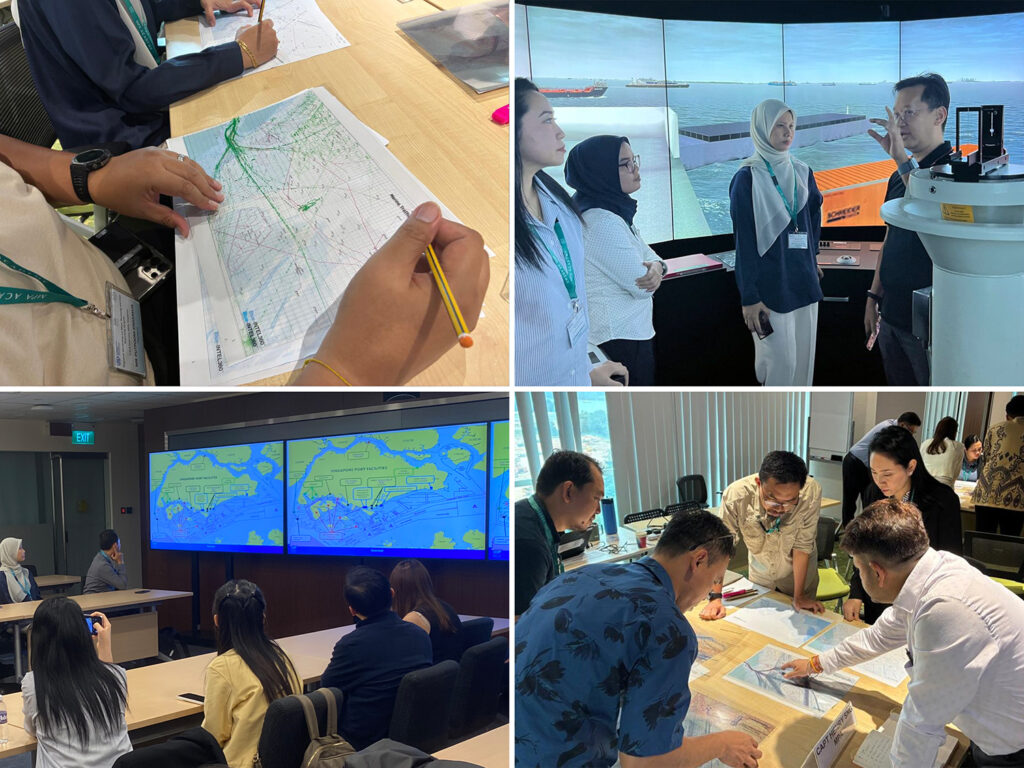
The programme combined theoretical instruction with practical exercises, including on-site visits to the Vessel Traffic Information System (VTIS)1 operations centre and the Integrated Simulation Centre (ISC)2 by the Maritime and Port Authority of Singapore (MPA)3.
Introduction to AIS
Participants explored the use of Automatic Identification System (AIS)4 data in supporting reporting requirements and its potential to reduce the need for traditional voice reporting from ships which should focus on navigating ships.
Consideration of UNCLOS and SOLAS
Sessions emphasized that routeing measures must be designed with due consideration for the rights of international shipping under UNCLOS5 and SOLAS6 Conventions.
The workshop was expected to serve as a model for future training initiatives, assisting participants in enhancing navigational safety and preventing marine pollution through effective ships’ routeing and reporting systems.
IMO’s ITCP
The event was delivered under the IMO Integrated Technical Cooperation Programme (ITCP)7, in collaboration with the Maritime and Port Authority of Singapore (MPA) and supported through the IMO-Singapore Third Country Training Programme (TCTP)8.
*Participants included sixteen representatives from: Cambodia, Indonesia, Malaysia, the Philippines, Singapore, Sri Lanka and Thailand.
1 https://www.mpa.gov.sg/port-marine-ops/operations/vessel-traffic-information-system
2 https://www.mpa.gov.sg/events-careers/education-and-scholarships/integrated-simulation-centre
4 https://www.imo.org/en/ourwork/safety/pages/ais.aspx
5 https://www.imo.org/en/ourwork/legal/pages/unitednationsconventiononthelawofthesea.aspx
7 https://www.imo.org/en/ourwork/technicalcooperation/pages/itcp.aspx
Text based on material kindly provided by the IMO media service
Illustration per www.imo.org
IMO ©
IALA e-Bulletin Rapporteur: Paul Ridgway