

Why the S-200 series Product Specifications
is the key to modern maritime safety?
As the maritime industry shifts toward a fully digital ecosystem, the role of the International Organization for Marine Aids to Navigation (IALA), has never been more pivotal. Within the overarching S-100 framework established by the International Hydrographic Organization (IHO), IALA fulfills a dual role of immense responsibility: we serve as both the “Domain Control Body” (the Manager) and the “Submitting Organization” (the Author) for the domain of aids to navigation (AtoNs), VTS and communication including AIS, ASM and VDES. In essence, IALA acts as both the architect and the builder of the Product Specification that will define the future of maritime services.
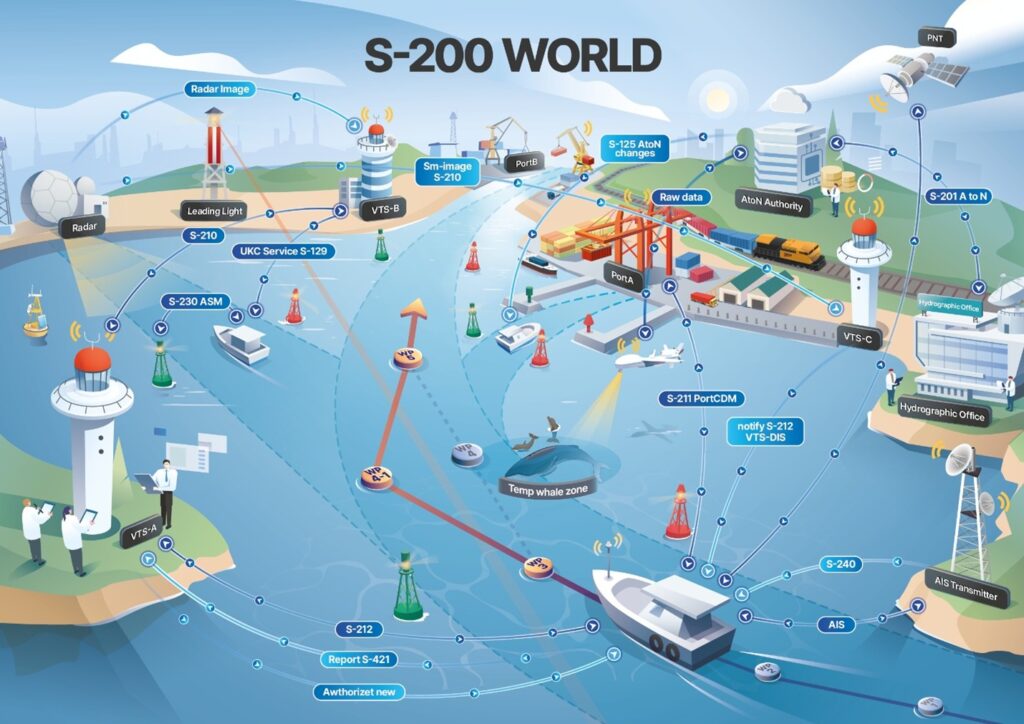
The S-200 series is our dedicated contribution to this global effort. It represents a comprehensive digital transformation of AtoNs, Vessel Traffic Services (VTS), and Positioning, Navigation, and Timing (PNT) systems. By collaborating closely with the IHO, we are ensuring that IALA’s expertise is woven into the very fabric of next-generation navigation.
A Turning Point for S-100 ECDIS
The countdown has begun. From 1 January, 2029, the adoption of S-100 based ECDIS will become a mandatory carriage requirement for all new installations. This is not merely a technical suggestion; it is a regulatory milestone that requires the entire global shipping industry to move in unison.
While the legacy S-57 based ECDIS was effectively a static framework, one that lacked standard extensibility and was unable to support modern requirements for 3D visualization, dynamic updates, or time-series data, the new S-100 ECDIS is a “dynamic platform”. It is designed for real-time data exchange, intelligent distribution, and improved presentation. For this platform to succeed, it requires the high-quality, standardized data layers provided by the S-200 series. Investing in S-200 now is not just about compliance—it is about ensuring your organization is ready to provide the services that the modern mariner will demand.
The S-200 Portfolio: Harmonized and Interoperable
The S-200 domain is vast, covering every critical aspect of IALA’s expertise. By utilizing the IHO GI (Geospatial Information) Registry as a standardized “dictionary,” we ensure that every piece of data is interoperable with other S-100 layers. Our portfolio includes:
- S-201 – S-209 (Aids to Navigation): Moving beyond simple location data to include dynamic status and maintenance history.
- S-210 – S-219 (Vessel Traffic Services): Facilitating inter-VTS exchange (S-210) and the crucial VTS digital information (S-212).
- S-220 – S-239 (Communications): Covering AIS, ASM, and the emerging VDES standards.
- S-240 – S-249 (PNT Systems): Standardizing terrestrial-based augmentation like eLoran to provide resilience against GNSS jamming.
A prime example of this innovation is the synergy between S-201 and S-125. The frequent and periodic exchange of AtoN change information between National AtoN Authorities and National Hydrographic Offices is a cornerstone of this digital evolution. By utilizing the S-201 standardized format, which is engineered by IALA to be fully compatible with S-101 ENCs, countries can establish a standardized digital pipeline for maritime information delivery. This S-201 based management framework ensures that AtoN data remains current and authoritative, laying the essential foundation to provide mariners with the precise, real-time change information they require. Currently, Analysis from various Coastal States reveals that more than 50% of Notice to Mariners content is consistently related to routine AtoN changes. By automating this through S-125, ships will receive instant updates on malfunctioning buoys or status changes, eliminating the week-long wait for manual chart updates and significantly enhancing navigational safety.
Furthermore, as we transition to these dynamic services, Cybersecurity remains a paramount challenge. We must ensure that the “digital pipe” through which data flows is resilient against manipulation and unauthorized access from shore to ship. IALA’s focus on the “Technical Service” layer is specifically designed to solve these challenges through secure protocols like SECOM.
From Development to Production: A Call to Action
For years, our focus has been on drafting and stabilizing technical standards. Now that several of these standards have reached a mature phase, our next critical step is data production. Digitalization has massive potential, but it will fail if the organizations operating it are not producing the actual “bits and bytes” required by the system. IALA urges all Member States to begin transitioning from legacy databases to S-200 compliant data production environments immediately.
Proving the Concept: The Sea Trials
The viability of our vision has been proven through Sea Trials conducted in the Republic of Korea and Singapore. Using the SECOM protocol over high-speed 4G and 5G networks, these trials successfully demonstrated seamless, end-to-end data exchange between shore and ship.
The trial showed that a ship could identify available services via the Maritime Service Registry (MSR), request a “Get Summary” of relevant data for its route, and receive real-time updates of S-124 and S-125 services. This was not just a test; it was a demonstration that the S-200 framework is ready for implementation.
Capacity Building: Empowering Data Production
IALA WWA, with the invaluable support of the IHO, General Lighthouse Authorities Research & Development GRAD, Korea Research Institute of Ships and Ocean Engineering KRISO, and United Kingdom Hydrographic Office UKHO, has successfully conducted three intensive S-200 training sessions to date. These programs are critical milestones in our global digital roadmap. Rather than focusing solely on theoretical concepts, these sessions provide concrete, hands-on methodologies that enable every Member State to begin producing, validating, and managing their own S-200 compliant data.
The training is essential for bridging the “semantic gap” — the fundamental differences in how various maritime organizations define and categorize information. By harmonizing these definitions through practical exercise, we empower our members to modernize their administrative workflows and take a leading role in the digital transition.
Recognizing the high demand and the technical necessity of these skills, IALA is committed to providing ongoing training sessions in the future. We strongly encourage all members to consider participating in upcoming programs. Ensuring your personnel are equipped with these practical data production skills is the most effective way to guarantee your organization’s readiness for the e-Navigation with S-100 era.
The momentum will culminate this September at the 3rd Joint IHO/IALA Workshop in Istanbul (1 September to 4 September). Following the foundational work in Norway (2022) and the technical integration focus in the USA (2024), the Istanbul workshop will facilitate advanced bilateral consultations. Our primary objective is to synchronize technical standards and finalize coordination on product specifications to ensure we meet the 2029 global implementation deadlines.
IALA e-Bulletin Rapporteur: Paul Ridgway.