

Maritime Autonomous Surface Ships (MASS)
IALA has proactively sought to establish the short to medium term outlook for MASS. This benefits our members by better equipping them to prepare for a future that involves an increasing number of autonomous ships.
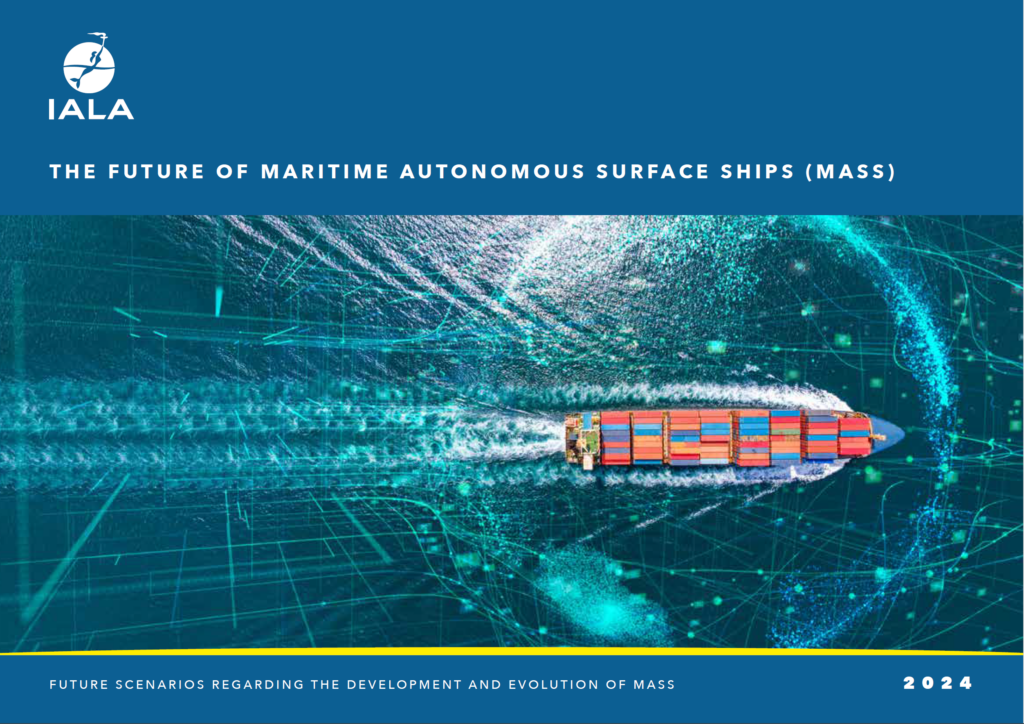
The Future of Maritime Autonomous Surface Ships (MASS) document considers the outlook for the gradual adoption of MASS over the next twenty years and potential drivers and challenges for the technology. With its publication, IALA aims to contribute significantly to the conversation surrounding the integration of automated and autonomous technologies in the maritime domain.
The Future of Maritime Autonomous Surface Ships (MASS) document can be downloaded here.
MASS work in IALA
Background
The development of MASS will bring about change to shipping, port operations and the safety of navigation. It is important to assess and discuss its impact on IALA related services at an early stage of its development.
IALA has been monitoring the development of MASS and some work on guidance documents has been initiated.
To integrate new and advancing MASS technologies into its regulatory framework, IMO carried out a regulatory scoping exercise, launched at MSC 100 in 2018 and completed in 2021. In May 2026, the Maritime Safety Committee, at its 111th session, adopted the International Code of Safety for Maritime Autonomous Surface Ships (MASS Code), a non-mandatory, goal-based Code that took effect on 1 July 2026. A mandatory Code is expected to be adopted by 1 July 2030 and to enter into force on 1 January 2032. These developments equally affect the work of IALA.
Scope of the MASS workflow in IALA
To develop a regulatory framework for MASS and MASS-related infrastructure on the relevant Marine Aids to Navigation including VTS, it is necessary to consider MASS operations from the technological level, as well as the regulatory level. As MASS-related work spans several IALA committees, an inter-committee MASS Task Force was formed under the Policy Advisory Panel to coordinate the work across committees and to align the committee outputs presented to the IALA Council. The Task Force is currently suspended. MASS-related work continues in the technical committees.

Resources
If you have more reference documents, please contact the secretariat (tm@iala.int) to share them on this page.
MASS case studies
As part of its work on the implications of MASS from a VTS perspective, the VTS Committee compiled case studies as a means of reaching a common understanding of MASS and its implications for the provision of VTS. Case studies give insight into trials and testbeds being conducted, their outcomes, lessons learnt and implications for VTS.
The working document (VTS51, January 2022) can be downloaded below.