


The birth of a Franco-Japanese Lighthouses Twinning Partnership, Kannonsaki Lighthouse and the Phare du Millier
Illuminating a new future between France and Japan
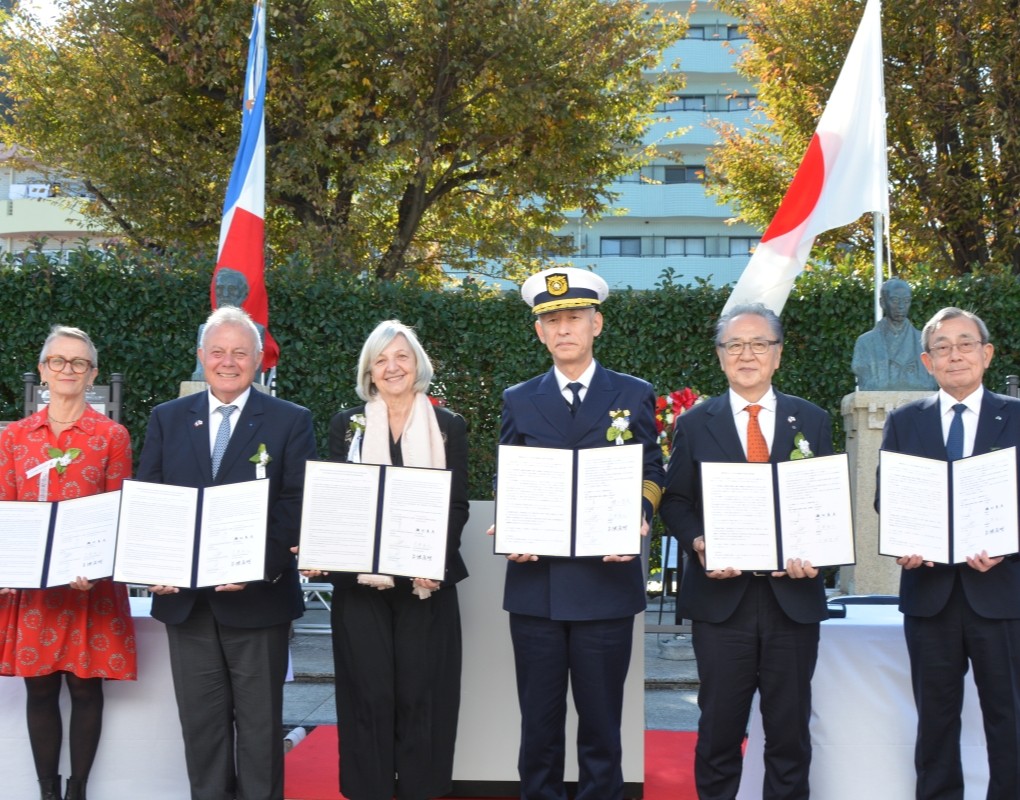
Organised by the City of Yokosuka, the ceremony took place following the Verny-Oguri Festival Ceremony hosted by the city. The Memorandum of Cooperation was signed by seven institutions: the Japan Coast Guard, the City of Yokosuka (Kanagawa Prefecture), the Tokokai (a public interest incorporated association), the Directorate-General for Maritime Affairs, Fisheries and Aquaculture of the French Ministry of the Sea and Fisheries, the municipality of Beuzec-Cap-Sizun (where Phare du Millier is located), the city of Brest (twinned with Yokosuka) and the Association Maison-Phare du Millier, resulting in the birth of the Franco-Japanese Twinned Lighthouses Partnership.
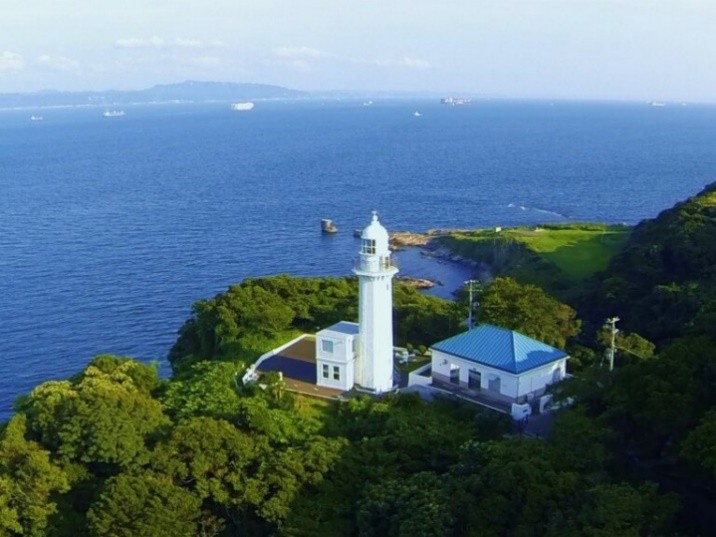
The Kannonsaki Lighthouse is the first Western-style lighthouse built in Japan. Construction began on 1 November 1868 under the supervision of a French engineer, and it was first lit on 11 February 1869. It was damaged several times thereafter, notably during the Great Kanto Earthquake of 1923, and the current building is the third generation.
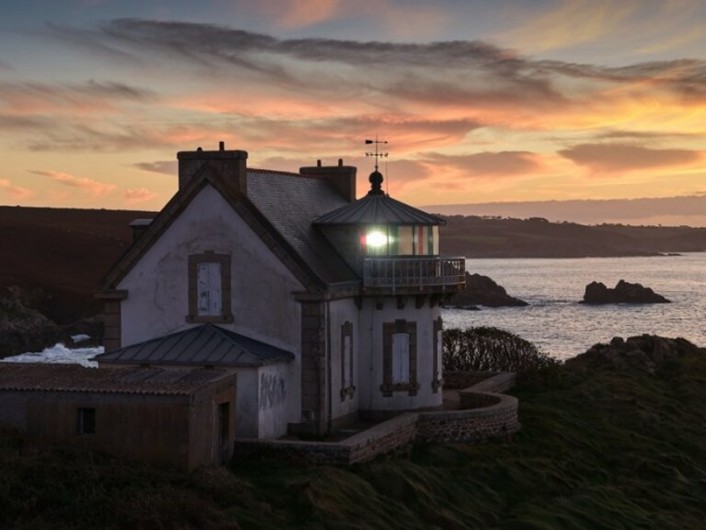
The Phare du Millier, situated on the Pointe du Millier in the municipality of Beuzec-Cap-Sizun, was designed by the French engineer Armand de La Noë and lit for the first time in March 1881.
This Twinned Lighthouses Partnership came about thanks to several historical similarities between the two lighthouses, as well as the initiative of a Japanese painter.
The first common feature lies in the use of French-made Fresnel lenses. Designed in the 19th century by the French physicist Augustin Jean Fresnel, these special lenses enable a lighthouse’s light to be projected over long distances: thin and lightweight, they effectively concentrate the light to project it far into the distance.
The second similarity concerns their appearance. The English word ‘lighthouse’ reminds us that, for a long time, lighthouse keepers lived and worked on site to maintain the light. The first Kannonsaki Lighthouse and the Phare du Millier both feature a house-like architectural form, making it easy to imagine that lighthouse keepers once resided on site.
The third common feature relates to the fact that the department of Finistère is closely linked to François Léonce Verny, who was involved in the construction of the Kannonsaki Lighthouse. Having arrived in Japan at the request of the Edo shogunate, Verny played a major role in the country’s modernisation, notably by overseeing the construction of the Yokosuka naval arsenal and the Kannonsaki Lighthouse, alongside the Florent brothers. Verny began his career at the Brest naval dockyard; moreover, the town of Quimper is home to the Florent brothers’ grave, where an imperial chrysanthemum emblem presented by the Japanese imperial family is preserved, along with a memorial stone commemorating the award of the title of Officer of the Imperial Order of the Rising Sun of Japan.
Finally, the initiative also owes a great deal to the Japanese lighthouse painter Toru Takeishi. After retiring from his post as a high school teacher, he set out to visit the lighthouses of Japan; once this journey was complete, he travelled to the United Kingdom, France and Ireland, visiting numerous lighthouses by bicycle and producing hundreds of sketches. The encounters he had in France during this time and the wish expressed by some of the people he met to exhibit his works in France were among the factors that led to the Twinned Lighthouses Partnership.
Fully embracing the spirit of this cooperation, Toru Takeishi generously created and donated two oil paintings depicting the Phare du Millier: one for the Kannonsaki Lighthouse and the other for Phare du Millier, thereby forging a new symbolic link between the two sites.
On the day of the signing, numerous French and Japanese representatives gathered at Verny Park in Yokosuka — a site named in honour of Verny’s actions — including Yoshio Seguchi, Director-General of the Japanese Coast Guard, Katsuaki Kamiji, Mayor of Yokosuka, Shigeto Kubo, President of the Tokokai, Béatrice Le Fraper du Hellen, French Ambassador to Japan, Fortune Pellicano, Deputy Mayor of Brest, Didier Guillion, Vice-President of the Finistère Departmental Council, and Christine Cornet, President of the Association Maison-Phare du Millier.
Following the ceremony, an official handover of the paintings and a tour of the Kannonsaki Lighthouse were organised, marking the practical launch of activities as the Twinned Lighthouses Partnership.
In future, the two lighthouses intend to preserve the memory of their shared history and the figures who contributed to their construction, whilst deepening historical and cultural exchanges between their respective regions through joint exhibitions of documents, lighthouse tours and reciprocal visits and exchanges between the relevant parties, in order to strengthen ties between local communities.
IALA e-Bulletin Rapporteur: Paul Ridgway.