

Reef VTS – 21 Years of Safer Navigation through interaction with vessel traffic
Introduction
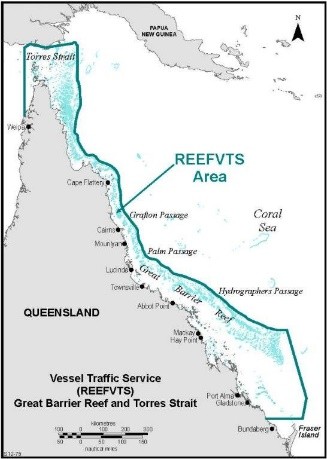
The Great Barrier Reef and Torres Strait comprise a complex network of islands and coral reefs extending over three thousand kilometres along the east coast of Australia.
The environmental and cultural significance of the region is recognised the world over. The Great Barrier Reef Marine Park was established in 1975 and added to the World Heritage list in 1981. In 1990 the International Maritime Organization (IMO) named the Great Barrier Reef as the world’s first Particularly Sensitive Sea Area (PSSA), followed by the Torres Strait in 2005.
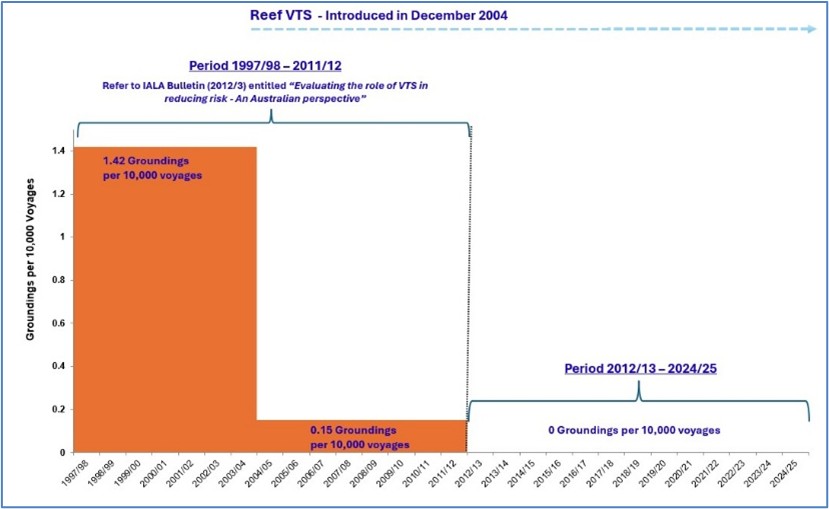
In 2012, IALA published an article entitled Evaluating the role of VTS in reducing risk – An Australian perspective, highlighting that in its first seven years of operation, the number of groundings in the Great Barrier Reef and Torres Strait per year had declined from 1.42 per 10,000 transits for participating ships to 0.15 per 10,000 transits, a reduction of 89 per cent.
The reduction in groundings was attributed to Reef VTS providing the capability to interact with participating and respond to developing situations within the VTS area to improve safety and efficiency of navigation, contribute to the safety of life at sea and support the protection of the environment.
This article focusses on how the VTS has continued to mitigate the risk of groundings in the area and enhanced/additional measures introduced since the 2012 publication.
Reef VTS 2004/05 – 2024/25
Since the 2012 IALA paper was published, the number of groundings per 10,000 transits has declined from 0.15 per 10,000 voyages to zero (Figure 1).
This can be attributed to both enhancements to the VTS system and additional measures, including:
- Enhancements to the VTS
Key enhancements introduced during this period include:
| July 2015 | Redundancy – Redundancy was introduced, allowing Reef VTS operations to be transferred to Gladstone VTS within 2-hours in the event of an outage at the Townsville VTS Centre (e.g. during a cyclone). |
| May 2020 | Decision Support – A new Decision Support Tool and enhanced business rules were implemented to identify situations where a ship does not alter course at a critical waypoint, deviates from a recommended route or may be in danger of running aground. |
| July 2021 | Dual VTS Centres – dual systems were introduced at both Townsville VTS and Gladstone VTS centres, enabling seamless operation of Reef VTS across two defined sectors: Reef VTS Sector North is managed by Townsville VTS.Reef VTS Sector South is managed by Gladstone VTS. This configuration allows instantaneous transfer of operations between the two centres, ensuring uninterrupted business continuity in the event of system outages, natural disasters, or other disruptions. The dual-centre model enhances operational resilience and ensures that VTS personnel are familiar with both sectors, supporting consistent and effective traffic management across the entire Reef VTS area. |
| May 2025 | Alternating VTS Operations (North and South) – Reef VTS operations are swapped between the two VTS centres for three months every six months to ensure VTS personnel maintain awareness of both areas. |
- Additional measures
Additional measures adopted include:
- December 2014 – IMO adopted two-way route established in the Great Barrier Reef (GBR) and Torres Strait region.
- Ongoing – Reef VTS maintaining ISO9001 quality management accreditation.
Summary
VTS plays a key role in responding to developing situations by interacting with vessels to improve safety and efficiency of navigation, contribute to the safety of life at sea and support the protection of the environment. This role is recognised in SOLAS V/12 and IMO Resolution 1158(32).
There are few published papers documenting their contribution and readers involved with VTS are encouraged to share their experiences with IALA (tso@iala.int).
Could another grounding occur in the Reef VTS area? The answer is unfortunately yes, as the risks of human error and mechanical failure are always present. However, through ongoing assessment of mitigation measures and a commitment to continuous improvement, the risk can continue to be effectively managed.
| Under Australian law, Maritime Safety Queensland (MSQ), a state government body, is the authorised VTS provider for REEFVTS and the Australian Maritime Safety Authority (AMSA) is the Competent Authority for VTS. Further information on REEFVTS is available at: https://www.msq.qld.gov.au/Shipping/Reefvts.aspx https://www.amsa.gov.au/safety-navigation/navigating-coastal-waters/great-barrier-reef-and-torres-strait-vessel-traffic |
Joanne McGraw, A/g Director VTS, Maritime Safety Queensland
Kerrie Abercrombie, Advisor, VTS, Australian Maritime Safety Authority
Daniel Frost, former Director VTS, Maritime Safety Queensland
Neil Trainor, IHMA, former Manager, Reef VTS
Rapporteur: Paul Ridgway.